


I've been around swimming my whole life, as an athlete chasing the 50 free at the Olympics, and as a coach trying to build the fastest swimmers in the world. In all that time, one thing hasn't changed nearly enough: the tools we use to train.
Think about it. Drag suits. Parachutes. Stretch cords. Power towers. T-shirts pulled over a suit. The weight room. These are the same tools we've been using for decades. They all work. I've used every one of them, and I still do. But they share the same limitation. They only work in one place, for one part of the workout. The parachute lives in the pool. The barbell lives in the gym. The moment the set ends, the training stops.
I've always believed resistance training should be specific to the sport. In swimming, the whole game is producing force in a streamlined position. The dive, the underwater dolphin kick, the breakout, your stroke mechanics, the turns, the finish. Every fraction of a second comes from how efficiently you apply force while holding great body position. The best tools overload the athlete while keeping movement as close to race mechanics as possible.
But here's my frustration, and I think a lot of coaches feel it. There hasn't been much real innovation. We keep reaching for the same handful of tools and accepting the same handful of limitations. The sport deserves better. Not more of the same. Better.

What "better" actually means
For me, a better training tool has to do three things.
It has to add resistance without changing how the athlete moves. The second a tool distorts your stroke, it's teaching you to swim wrong. Whatever load you add has to sit on the movement, not fight it.
It has to work in more than one place. The best tool isn't locked to a single set or a single room. It should follow the athlete: in the water, in warm-up, in dryland, in the weight room, even walking around during the day.
It has to fit every athlete. A sprinter and a distance swimmer don't need the same load. A twelve-year-old and a national team athlete don't either. A good tool lets you dial it up or down without buying something different for every swimmer.
That combination, resistance that moves with you, works everywhere, and scales to anyone, is what's been missing.
Why I paid attention to KILOGEAR
I get pitched a lot of products. Most of them are a new version of something I already own. KILOGEAR was different, because it solved the limitation, not just the exercise.
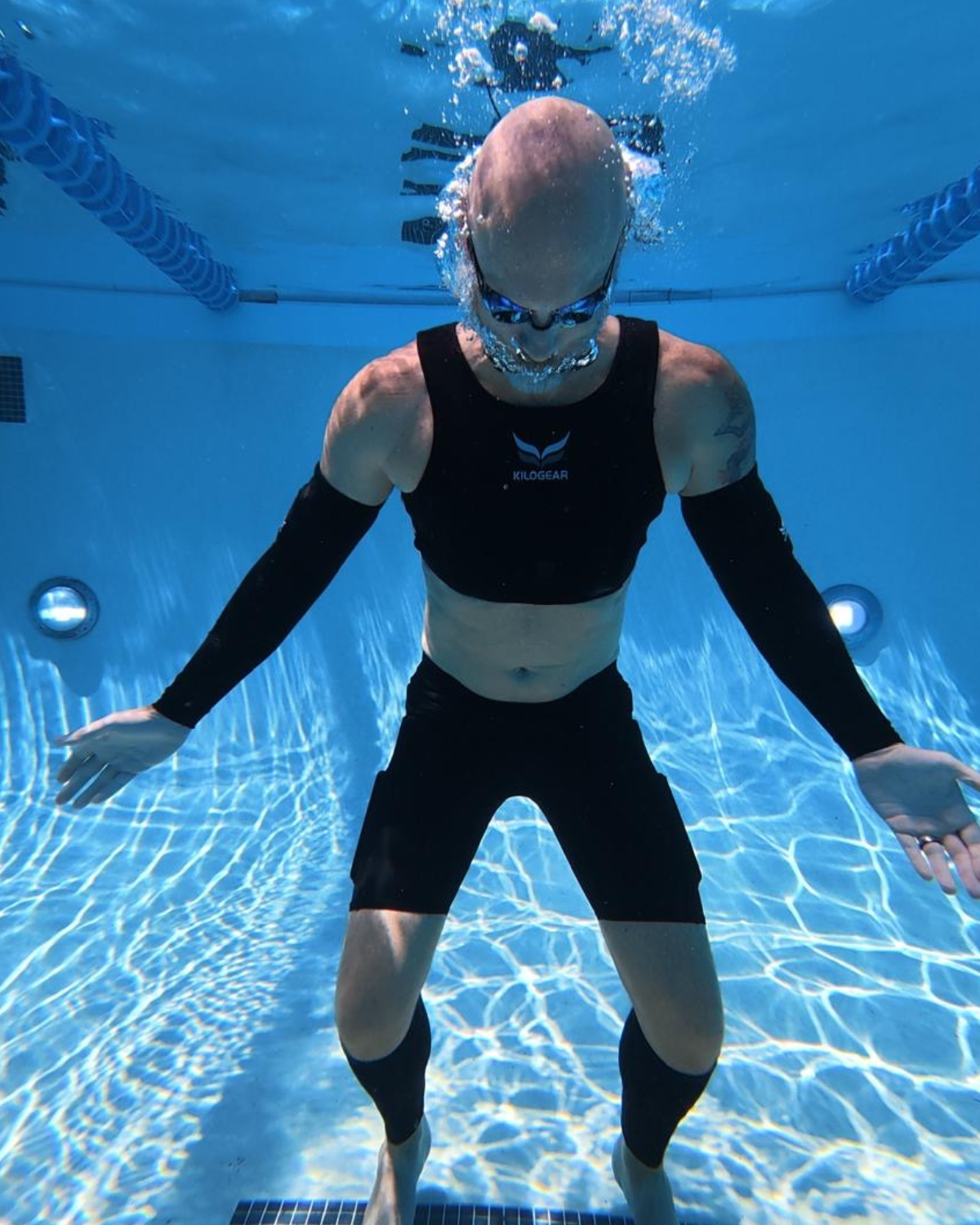
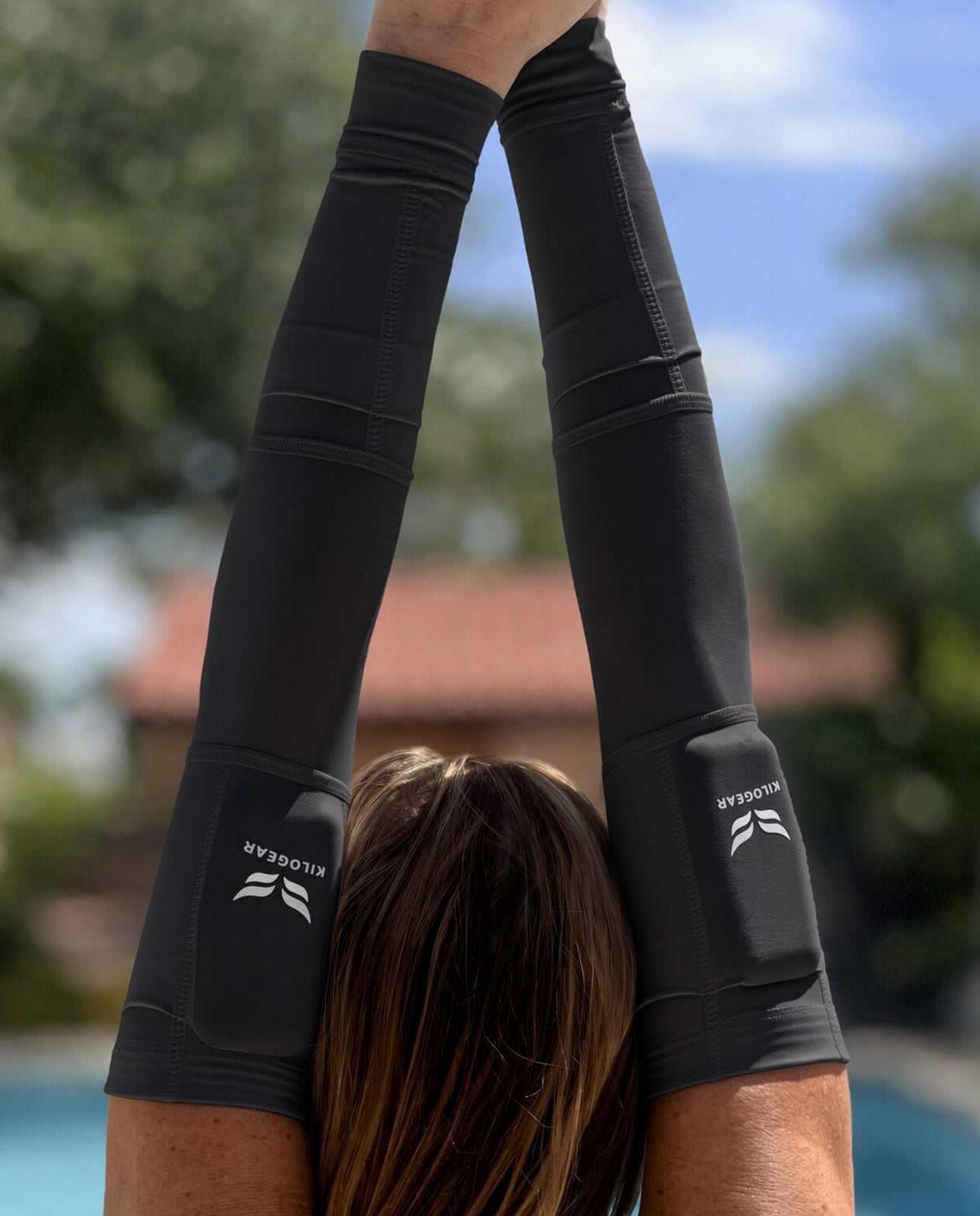
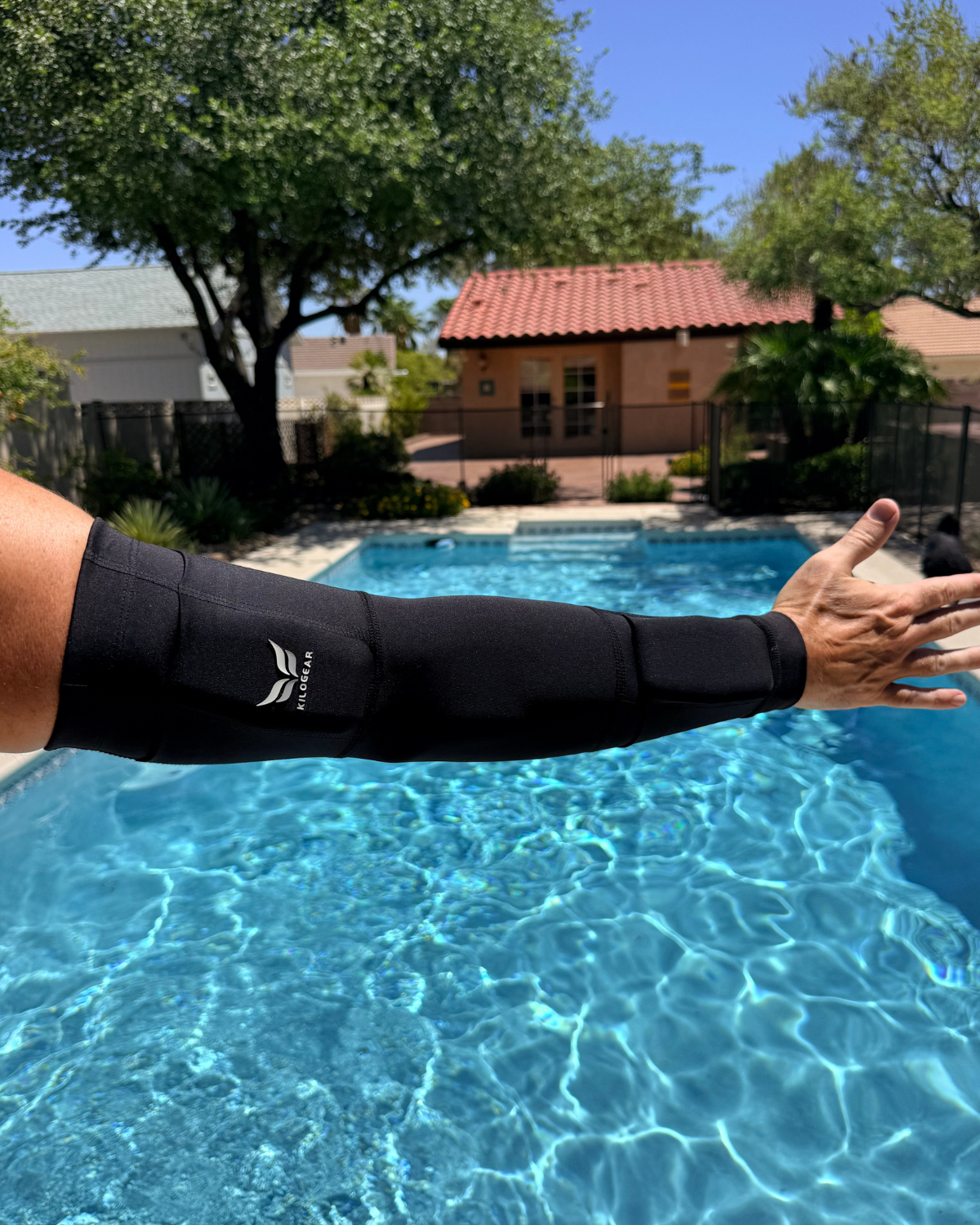
Here's what it actually is. KILOGEAR is compression gear, arm sleeves, calf sleeves, shorts, and vests with small removable weights that distribute across the muscle groups you're training. The weights come in two sizes, KILOMICRO at a quarter pound each and KILOMAX at half a pound, sold in two-packs. You load the pieces to the resistance you want, put them on, and train. No rack. No cords. No setup.

This next part is why it doesn't wreck technique, and it's the thing that actually convinced me.
Most resistance concentrates force at a single point. A parachute dragging behind you. A cord pulling from one direction. A weight hanging off one spot. That single point is what distorts the stroke, because your body has to fight it. Now, I want to be fair to those tools, because I still use them. Inside a short set, with a coach watching and a fresh athlete, they hold up fine. The distortion shows up as fatigue accumulates, which is exactly why you can only run them in short blocks before technique starts falling apart.
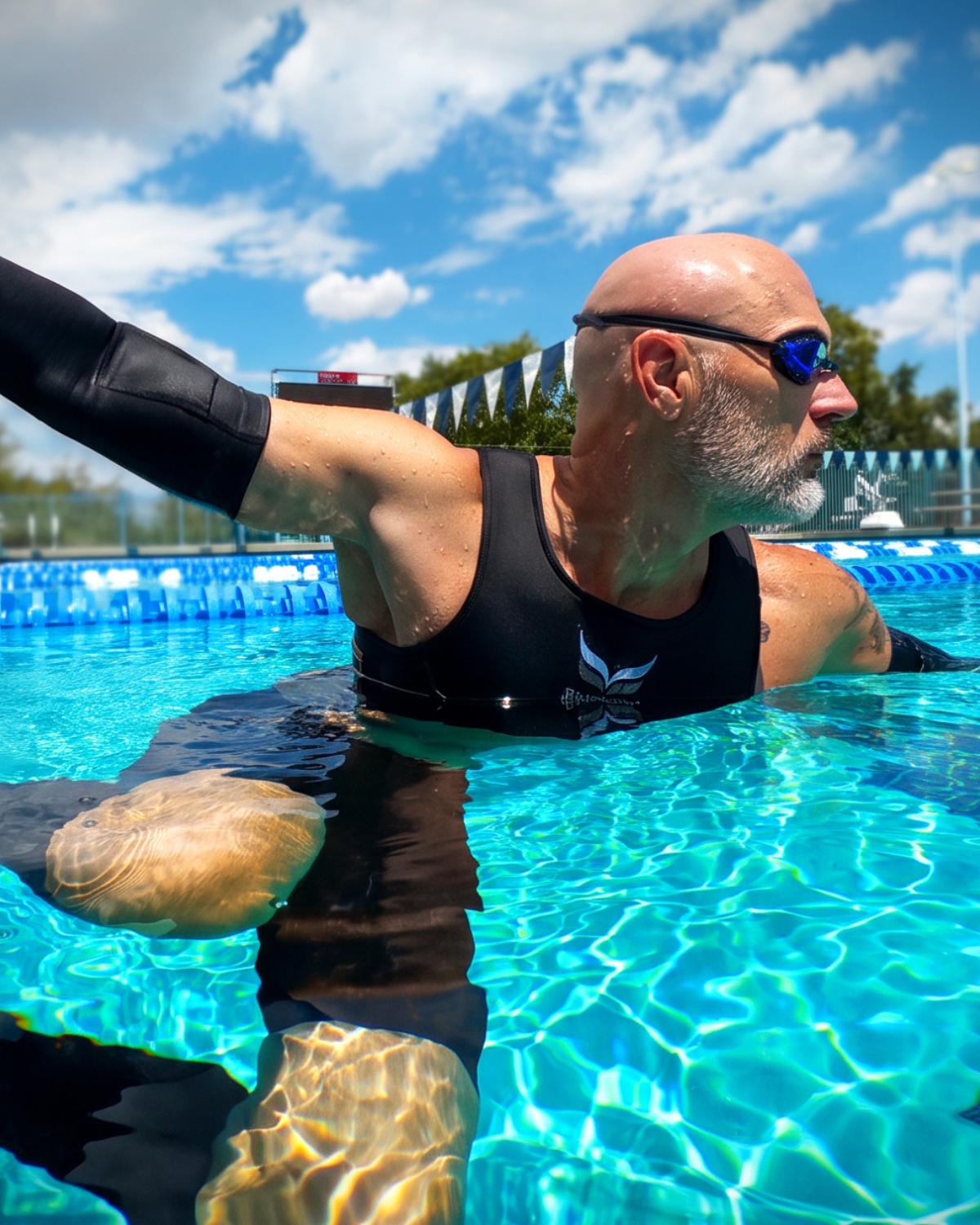
KILOGEAR spreads the load across the muscle groups instead of concentrating it at one point. The resistance is distributed the way your body's own effort is distributed, so you feel it everywhere and fight it nowhere. That's the difference between a tool that loads your movement and one that fights it.
The load sits on the muscle rather than hanging off a joint. It scales, light for a distance swimmer, heavier for a sprinter, adjustable as an athlete gets stronger. It works for a masters swimmer and it works for a kid.
And it's washable, which sounds minor until you coach swimmers. The weights come out and the garment goes in the machine. Think about what that means for a kid training six days a week in a chlorinated pool. Every other tool in my list, the drag suits, the T-shirts, they get worn, they get gross, they hold the water and the chlorine. This doesn't. Pull the weights, wash it, done.
I'll be honest about how I think about it. KILOGEAR doesn't replace the weight room. Every tool has a purpose. It sits alongside them and adds a layer the others can't.

How I would start a swimmer
We built three kits for swimming, and where you start depends on the athlete.
The KILOGEAR SPEED KIT for swim includes our long arm sleeves and 1/2 pound of load per arm. This is the entry point and where I'd put almost every swimmer first. It loads the arms while you swim, so every stroke builds pulling power. Pull is where most of your propulsion comes from. Start here.
The KILOGEAR POWER KIT Kit for swim adds calf sleeves and 1 pound of KILOMAX weights per leg. Now the kick joins the pull, and you're training how the whole stroke connects. Arm speed, leg drive, and timing, all under resistance. Load heavy and short for sprint work, or lighter and longer for distance.
The KILOGEAR MAX VELO KIT for Men and the KILOGEAR MAX VELO KIT for Women adds compression shorts. Arms, calves, and quads at once, which means you're loading the pull, the kick, and the drive off every wall. Five pounds of adjustable load to start, dialed to the swimmer, the stroke, and the distance. Men's and women's fits.
If you're a coach reading this: I'd also tell you to wear it yourself. We spend endless hours walking up and down the pool deck. That's a lot of movement going to waste.
Start light, start short
Three rules, and they apply to every athlete I've ever coached.
- Start light. Fewer weights than you think you need. You can always add.
- Start short. One set, one block, one warm-up. Not a full practice on day one.
-
Watch the technique, not the clock. The moment stroke quality drops, the load comes off. That rule has never changed and it never will.
If a swimmer has a shoulder issue, a back issue, or is coming off an injury, that's a conversation with their doctor or physical therapist before anything gets loaded.
Where this series is going
This is the first of a series I'm writing on how swimmers actually get faster. How force turns into speed. Why the walls win races. Why sprinters and distance swimmers should train completely differently. And how to build young athletes the right way.
But it starts here, with a simple belief. The athletes chasing the highest level are always the first to adopt what gives them an edge. The tools should be chasing the same thing. Speed comes from strength, power, and precision, not from more of the same.
Let's build better.
Frequently Asked Questions
1. Can you actually swim in KILOGEAR? Yes. The apparel is a poly-spandex blend and the weights are fully encapsulated in silicone, so there's no metal exposed to the water and nothing that corrodes. That said, check with your facility first. Some pools have their own rules about what can be worn in the water, and it's a five-second conversation with your aquatics director that saves you a hassle later. Rinse the garment after swimming the same way you'd rinse a race suit.
2. Will it change my stroke? That's the right question to ask, and it's the first thing I checked. The load is distributed across the muscle groups rather than concentrated at one point, which is what lets it add resistance without pulling your body out of position. The rule still applies though: if you see stroke quality drop, take weight off. No tool is immune to being overloaded.
3. How much weight should a swimmer start with? Less than you think. The weights come in quarter-pound and half-pound increments specifically so you can build gradually. Start with the lightest configuration in the kit, run it through a warm-up or a single set, and see how the athlete moves before adding anything. A sprinter and a distance swimmer will end up in very different places, and both should get there slowly.
4. Is it safe for young swimmers? The system scales down, which is the important part. A twelve-year-old and a national team athlete use the same apparel with completely different loads. For age group swimmers I'd stay at the lightest setting, keep it to short blocks, and have a coach watching technique the whole time. If a young athlete has any existing injury or pain, talk to their doctor first.
5. Does it replace dryland or the weight room? No. I still use the weight room, I still use cords, and I still use parachutes. KILOGEAR adds a layer those tools can't, which is resistance that isn't confined to one set or one room. Think of it as another tool in the box, not a replacement for the box.
6. Can coaches wear it? Yes, and I'd recommend it. Coaches spend hours on the pool deck every day. Wearing load through all that walking turns time you're already spending into something productive.
7. How do you wash it? Take the weights out and put the garment in the machine. That's the whole process. It's one of the practical reasons I liked the system, because anything that lives in a chlorinated pool six days a week needs to be washable.
8. What's the difference between the three swim kits? The Speed Kit is arm sleeves and loads the pull. The Power Kit adds calf sleeves so you're training the pull and the kick together. The Max Velo Kit adds compression shorts, which brings the quads and the push off the wall into it. Most swimmers should start with the Speed Kit and build from there.